Water Heater Pressure Relief Valve Leaking: Causes and Fixes
A water heater’s temperature and pressure (T&P) relief valve lets water out for one of three reasons: pressure in the tank is too high, the water is too hot, or the valve or its connection is faulty. A. O. Smith, a water heater maker, says slow “dribbling” or “weeping” means the valve is opening on pressure, which a closed plumbing system can cause. A sudden gush of very hot water means it’s opening on temperature, which A. O. Smith ties to “a malfunctioning thermostat.” Either way, the valve is a safety device: never plug or cap it or its pipe, keep clear of the pipe’s end, and have a licensed plumber find out why it’s opening.
What the valve does
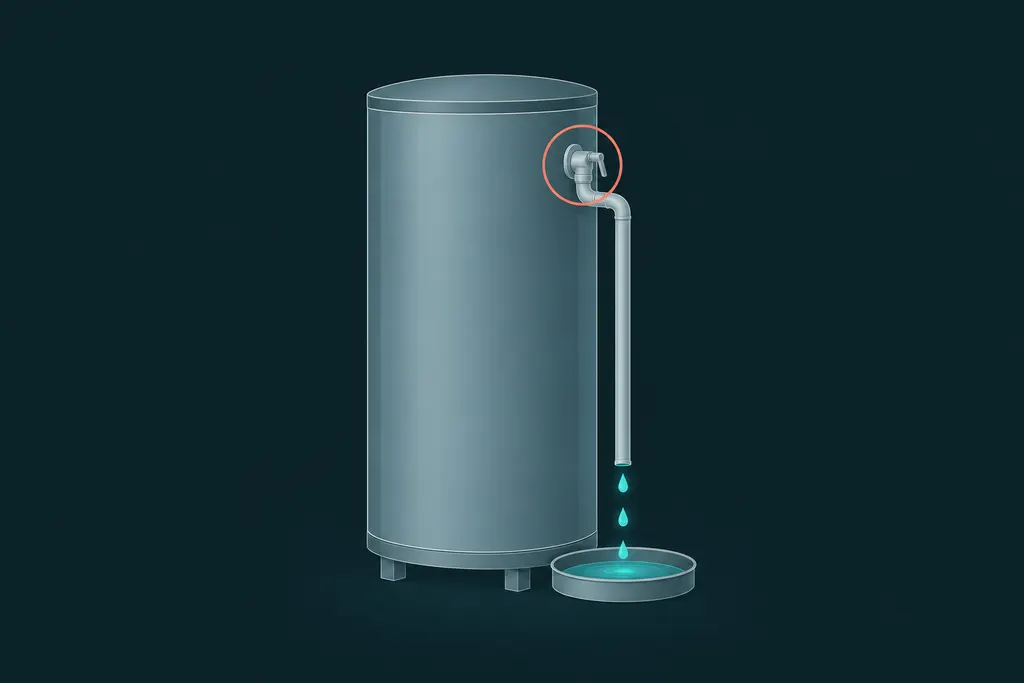
The T&P valve is “typically mounted at the top of the water heater tank or on the side near the top,” says This Old House. A probe from the valve reaches into the top six inches of the tank. A. O. Smith says the valve normally has “a temperature rating for 210°F,” and a pressure rating no higher than the tank’s working pressure, “generally 150 psi.” When pressure reaches the rating, the valve opens slightly, which shows up as “dribbling” or “weeping.” When the temperature goes over the rating, it opens fully, releasing “very hot” water.
The discharge pipe carries that water down toward the floor. A. O. Smith’s gas heater manual says the line must not be smaller than the valve outlet, must not be “capped, blocked, plugged or contain any valve,” and must end no more than six inches above a floor drain, or outside.
Never plug or cap the valve
A. O. Smith’s manual puts it in a warning box: “If the temperature and pressure relief valve is dripping or leaking, have a qualified person replace it.” The same box says: “Do not plug valve. Do not remove valve. Failure to follow these instructions can result in death, or explosion.” This Old House’s Richard Trethewey says that if someone plugs a dripping valve, “you fundamentally turn that water heater into a bomb because this valve effectively can’t do its thing.” This Old House lists “any plugs or caps on the valve or discharge pipe” among the reasons to call a licensed plumber.
Common causes
| What you see | Likely cause, per A. O. Smith |
|---|---|
| Drips during heating, after hot water use, when nothing is running | Thermal expansion in a “closed” plumbing system (see below) |
| Drips, and your home’s water pressure is high | Supply pressure above the valve’s rating; “a pressure reducing valve will be needed” |
| A large burst of very hot water now and then | Temperature: “The only cause of this problem is a malfunctioning thermostat” |
| Water around the threads where the valve meets the tank | A leaking threaded connection; a plumber reseals it |
| Water seeping at the welded fitting the valve screws into | “Spuds are welded to the tank and are not repairable. The heater should be replaced.” |
Thermal expansion needs a word of explanation. Water expands as it heats. Many water systems have a check valve at the water meter, and a pressure-reducing valve, a backflow preventer or a water softener can act the same way, keeping that extra water from flowing back into the main. A. O. Smith calls this a closed system and gives an example: “Water in a closed tank at 50 psi, when heated just 10 degrees, will reach a pressure of 250 psi.” The pressure has to go somewhere, so the relief valve weeps. A. O. Smith says not to remove those check valves; they serve a purpose. Its fix is a properly sized expansion tank. On one This Old House house call, a homeowner had replaced three T&P valves and the leak went on. Trethewey suspected the valve was “doing its job exactly”; the cause was thermal expansion, and This Old House says that in cases like this “the fix isn’t a new valve but an expansion tank.”
A worn valve is the other possibility. This Old House lists “a faulty valve that needs replacement,” along with “excessive pressure in the system” and “temperature settings that are too high.” It adds that valves can stick from “mineral buildup, corrosion, or lack of use.”
How urgent is it?
Hot water gushing from the pipe: call a plumber now. Keep everyone away from the end of the discharge pipe. CPSC says “most adults will suffer third-degree burns if exposed to 150 degree water for two seconds,” and the valve is built to open at about 210°F. Tell the plumber the water is coming out hot. A. O. Smith links that to the thermostat.
A slow, steady drip: book a plumber soon. On another This Old House house call, a homeowner described a drip that went from a jar emptied once a week to a bucket “we had to empty three times a day.” A. O. Smith’s manual says thermal expansion “can cause premature tank failure (leakage),” and that this kind of failure “is not covered under the limited warranty.”
No discharge pipe, or a capped or plugged one: call a plumber to correct it, even if nothing is dripping.
Don’t test the valve yourself. A. O. Smith warns that if you touch the relief valve while the heater is running, “scalding water can shoot out, causing serious burns.” Ask a plumber to test it.
What a plumber will do
- Measure your water pressure and check whether your plumbing is a closed system. A. O. Smith’s guide says household pressure “should be 50-60 PSI and no higher than 80 PSI.”
- Add an expansion tank, a pressure-reducing valve, or both. A. O. Smith’s “ideal fix” is a pressure-reducing valve “if supply pressures are above 60 to 70 psi, and a properly sized expansion tank.”
- Check the thermostat if the valve released hot water.
- Replace the valve if it’s worn, with a new one rated no higher than the working pressure on the heater’s data plate. A. O. Smith says to use only a new valve, and that “if an incorrectly sized temperature and pressure relief valve is installed, the warranty will be void.” This Old House says T&P valve replacement should always be done by “a qualified professional.”
- Recommend a new heater if the welded fitting is seeping, or talk through repair versus replacement if the heater is old.
Repair cost factors
Figures from two guides, each for the work named:
| Work | Typical price | Source |
|---|---|---|
| Replace the pressure relief valve | $100–$250 | Fixr, 2025 |
| Fix “a water heater that has too much pressure” | $75–$350 | Fixr, 2025 |
| Expansion tank, where a city requires one when a new heater is installed | adds $40–$150 | This Old House, 2026 |
| New tank water heater, installed | $1,200–$2,300 | This Old House, 2026 |
| New tank water heater, installed | $600–$2,500 | Fixr, 2026 |
Neither guide gives a price for adding an expansion tank to an existing heater, so ask for a quote. Ask the plumber what’s making the valve open before you pay for a new valve. If the answer is a new heater, our repair-or-replace calculator helps you compare. Water elsewhere on the heater? See leaking from the top or leaking from the bottom, or use the Leak Finder.
Not sure where the water comes from?Run the Leak Finder →Sources
- A. O. Smith — Technical Bulletin #52: Leaking Temperature and Pressure Relief Valve (undated; accessed Oct 31, 2026)
- A. O. Smith — Technical Bulletin #45: Thermal Expansion (undated; accessed Oct 31, 2026)
- A. O. Smith — Technical Bulletin #51: Puddle on the Floor (undated; accessed Oct 31, 2026)
- A. O. Smith — Direct Vent Residential Gas Water Heater, Installation Instructions and Use & Care Guide (2013), pp. 14–16 (thermal expansion, relief valve, discharge line)
- A. O. Smith — Is Your Hot Water Not Getting Hot? Common Causes & What To Do About Them (undated; accessed Oct 31, 2026)
- This Old House — How and Why To Maintain a Temperature-and-Pressure Valve, by Richard Trethewey (updated Jun 3, 2026)
- U.S. Consumer Product Safety Commission — Avoiding Tap Water Scalds, Publication 5098 (print date code 03/2012)
- Fixr — Water Heater Repair Cost (updated Aug 29, 2025)
- Fixr — How Much Does It Cost to Install a Water Heater? (updated Jan 27, 2026)
- This Old House — How Much Does Water Heater Installation Cost? (updated Jun 17, 2026; cost data from The Home Depot and market research)
Checked 2026-10-31
Illustrations on this page are AI-generated to help you picture the situation. They are not photos of real homes, jobs or people.