Water Heater Leaking From the Top: Causes and Fixes
Water on top of a water heater comes from one of four places: the cold-in and hot-out pipe connections, the temperature and pressure (T&P) relief valve, the anode rod fitting, or condensation on cold pipes. Most of these are a problem with a part, not the tank. A. O. Smith, a water heater maker, says that for a leak at the top, “sometimes, tightening these connections can take care of the problem.” That’s a job for a plumber. The exception is water seeping at the fitting welded to the tank that the relief valve screws into; then A. O. Smith says the heater should be replaced. The pipes and valve on top can be scalding hot, so look but don’t touch, and have a licensed plumber make the repair.
What to do right now
- Look, don’t touch. A. O. Smith warns that if you touch the relief valve while the heater is running, “scalding water can shoot out, causing serious burns.”
- Watch where the water first appears, from a safe distance; a flashlight helps. Tell the plumber what you saw.
- Catch the drip with a pan or bucket, move anything that can get wet, and take photos.
- If water is spraying or running, shut off the water at the main valve or the cold-water shutoff above the heater, but only if you can reach it safely. Keep away from water near outlets or the heater’s electrical parts.
- If you smell gas near a gas water heater, leave the house and call your gas utility or 911 from outside. Washington’s utility regulator says to call “from a safe distance away from the odor.”
- Call a licensed plumber.
Where the water on top comes from
A. O. Smith’s electric water heater manual lists “leakage checkpoints” around the heater. These four are on or near the top:
| Where you see water | What A. O. Smith says it can be |
|---|---|
| On the hot and cold pipes | “Condensation and dripping may be seen on pipes if the water temperature is low in humid weather or pipe connections may be leaking.” |
| At the anode rod fitting | “The anode rod fitting may be leaking.” |
| From the T&P valve or its pipe | “Small amounts of water from temperature-pressure relief valve may be due to thermal expansion or high water pressure in your area.” |
| Where the T&P valve meets the tank | “The temperature-pressure relief valve may be leaking at the tank fitting.” |
A. O. Smith adds that “in warm or humid locations, condensation can accumulate and run down flue tubes, cold water supply pipe, and heater connections” (flue tubes are found on gas models). It adds that condensation “should only be noticeable after a long draw of hot water.” A connection that keeps dripping after the heater has warmed up is probably a leak.
Pipe connections and fittings
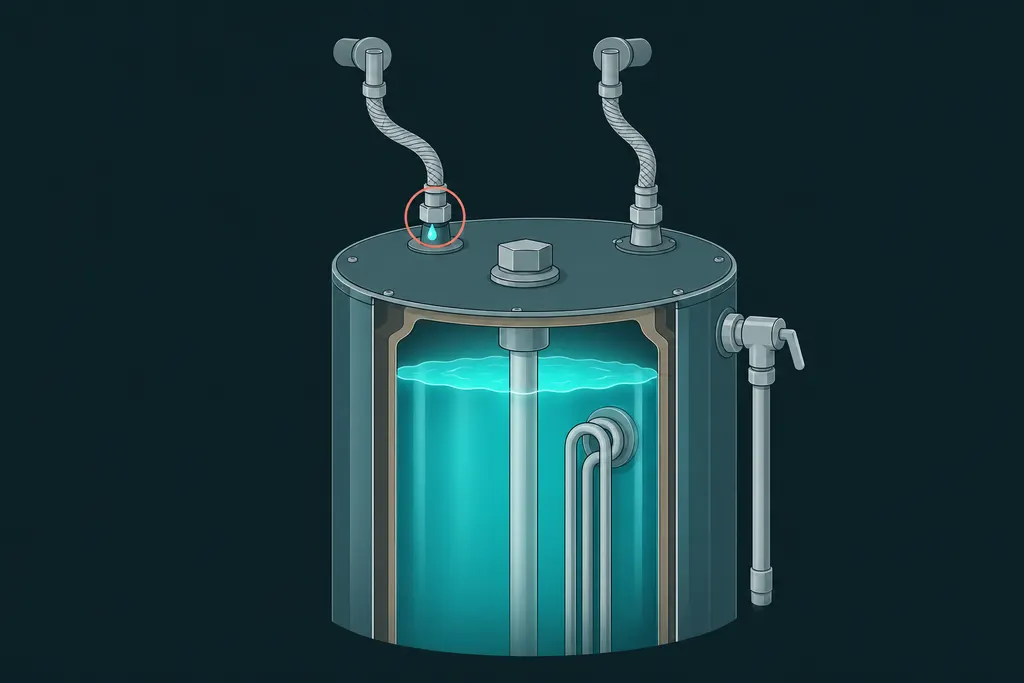
Two pipes connect at the top of a typical tank heater: cold water in and hot water out. Each one joins the tank through a threaded fitting, and A. O. Smith’s leak guide points to a shutoff valve on the cold line. A. O. Smith says “loose pipe connections can occur over time due to thermal expansion and general wear and tear,” and that “excessive water pressure can put undue stress on the water heater, leading to leaks in the tank or at plumbing connection points.” When pressure is the cause, it says installing a pressure-reducing valve or an expansion tank can solve it.
Sometimes a plumber only needs to tighten a fitting. Overtightening can damage it, so leave it to them. If water is coming from where a fitting threads into the tank, the fix in A. O. Smith’s manual is for the tank to be drained and the fitting taken out and resealed. That is work for a licensed plumber.
Relief valve and anode rod leaks
The T&P relief valve is “typically mounted at the top of the water heater tank or on the side near the top,” says This Old House. A. O. Smith says water from the valve or its discharge pipe “may represent relief valve activation”: the valve opening because of pressure or temperature, not necessarily a broken valve. That has its own page: pressure relief valve leaking. Water around the valve’s base is different. A. O. Smith’s bulletin on relief valves gives two cases:
- leakage at the threaded connection: a plumber removes the valve and reseals the threads;
- seeping at the spud, the fitting the valve screws into: “Spuds are welded to the tank and are not repairable. The heater should be replaced.”
Never plug or cap the relief valve or its pipe to stop a drip.
The anode rod is a metal rod that corrodes so the tank doesn’t. A. O. Smith’s service handbook for its power-vented gas models says the rod’s “hex-head plug end … is visible on the top of the water heater.” A. O. Smith says anode rods “usually last 3-5 years before they need to be replaced,” and its manual says to have the rod inspected “after a maximum of three years and annually thereafter.” A leak at its fitting is a sealing problem. Resealing or replacing the rod is a job for a plumber.
When to call a plumber, and what it costs
Call for any drip that isn’t condensation, any water from the relief valve, and any leak you can’t trace. Water that has run down the side can reach the floor; see water heater leaking from the bottom for those causes.
Prices from two guides, each for the work named:
| Repair | Typical price | Source |
|---|---|---|
| Fixing a leaking water heater (minor leaks to more serious ones) | $50–$600 | Fixr, 2025 |
| Valve repair (relief, drain or shutoff valve) | $75–$150 | Fixr, 2025 |
| Shutoff valve replacement | $100–$200 | Fixr, 2025 |
| Anode rod replacement | $125–$300 | Fixr, 2025 |
| Minor fixes, such as “small leaks at connections, sticky relief valves” | $150–$500 | This Old House, 2026 |
| New tank water heater, installed | $1,200–$2,300 | This Old House, 2026 |
| New tank water heater, installed | $600–$2,500 | Fixr, 2026 |
Most of the repairs above cost far less than a new heater. If the plumber finds a welded fitting seeping, or the heater is old, the choice becomes repair or replace. See how long water heaters last.
Questions to ask the plumber: Which fitting is leaking, and why? Is my water pressure too high, and do I need an expansion tank or a pressure-reducing valve? Is the tank itself sound?
Not sure the heater is the source? Try our Leak Finder.
Not sure where the water comes from?Run the Leak Finder →Sources
- A. O. Smith — Why Is My Water Heater Leaking? (manufacturer guide, undated; accessed Oct 31, 2026)
- A. O. Smith — Is Your Hot Water Not Getting Hot? Common Causes & What To Do About Them (undated; accessed Oct 31, 2026)
- A. O. Smith — Residential Electric Water Heaters Instruction Manual, Part No. 185762-002 (2012), p. 15 (anode rod) and p. 19 (Leakage Checkpoints)
- A. O. Smith — Technical Bulletin #51: Puddle on the Floor (undated; accessed Oct 31, 2026)
- A. O. Smith — Technical Bulletin #52: Leaking Temperature and Pressure Relief Valve (undated; accessed Oct 31, 2026)
- A. O. Smith — Service Handbook, Residential Gas Water Heaters, Power Vented Models (document 322153-000, undated), p. 2 (anode rod)
- This Old House — How and Why To Maintain a Temperature-and-Pressure Valve, by Richard Trethewey (updated Jun 3, 2026)
- This Old House — How Much Does Water Heater Installation Cost? (updated Jun 17, 2026; cost data from The Home Depot and market research)
- Fixr — Water Heater Repair Cost (updated Aug 29, 2025)
- Fixr — How Much Does It Cost to Install a Water Heater? (updated Jan 27, 2026)
- Washington Utilities and Transportation Commission — Pipeline Emergencies (undated; accessed Oct 31, 2026)
Checked 2026-10-31
Illustrations on this page are AI-generated to help you picture the situation. They are not photos of real homes, jobs or people.