Trenchless Sewer Repair Cost: Lining vs Pipe Bursting
Trenchless sewer repair is priced per linear foot of pipe, and the two main methods are priced separately. HomeGuide (December 2025) puts cured-in-place pipe (CIPP) lining at $90–$250 per linear foot and pipe bursting at $60–$200 per linear foot. Bob Vila’s 2023 guide (sources listed: Angi, HomeAdvisor, This Old House) gives $60–$200 per foot for pipe bursting; its cured-in-place figure, $80–$250, appears “per foot” in one section and “per square foot” in another. This Old House (March 2026) gives $60–$250 per linear foot for trenchless methods overall, against $50–$200 for traditional excavation. Your total depends on how many feet need work. A camera inspection ($125–$500 in HomeGuide) comes first, to see whether trenchless is possible at all.
Trenchless sewer repair cost by method
| Method, per linear foot | HomeGuide (Dec 2025) | Bob Vila (2023; Angi, HomeAdvisor, This Old House) | This Old House (2026) |
|---|---|---|---|
| Pipe lining, cured-in-place (CIPP) | $90–$250 | $80–$250 “per foot” in one section, “per square foot” in another | $60–$250 (all trenchless methods) |
| Pipe bursting | $60–$200 | $60–$200 | $60–$250 (all trenchless methods) |
| Spin-casting (sprayed resin lining) | $80–$250 | — | — |
| Traditional excavation, for comparison | — | — | $50–$200 |
Seattle Public Utilities gives two local figures for a repair that does not require digging: “$100-170 per foot for re-lining or pipe bursting” in one homeowner guide and “$60-$200 per foot” in another. The same utility notes that a repair requiring digging in the public right-of-way “would be even more costly.”
Pipe lining vs pipe bursting
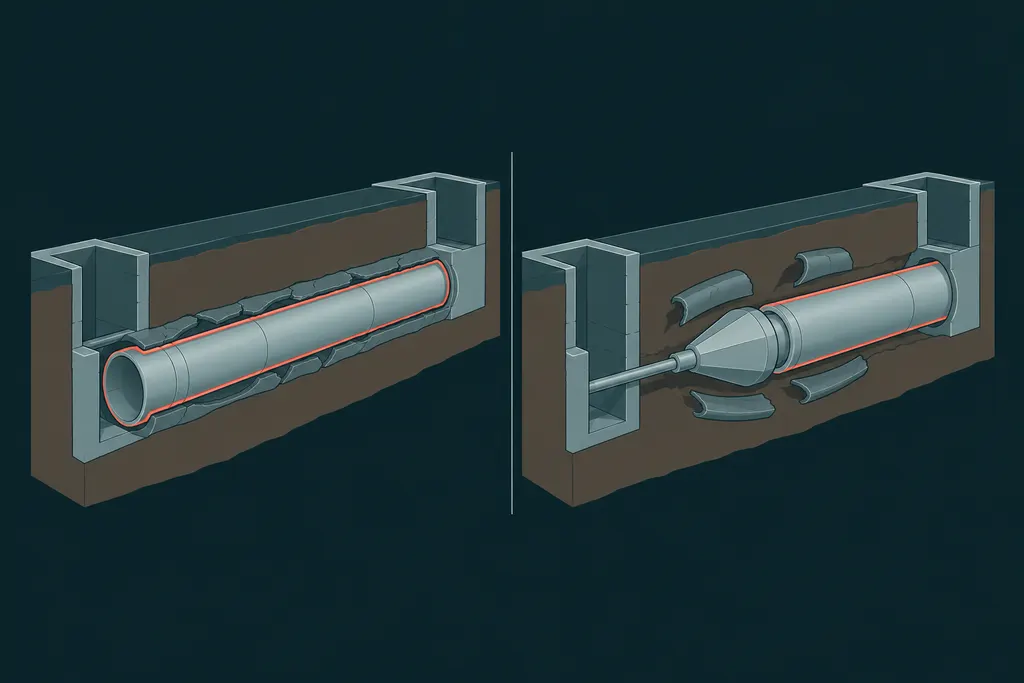
Pipe lining (CIPP) builds a new pipe inside the old one. Seattle Public Utilities describes it as “a resin-soaked felt tube liner” that is inserted, inflated to the shape of the existing pipe, and cured “to form a pipe within the old pipe.” According to This Old House, the pipe is inspected and cleaned first with hydro jetting, and after curing the connections to the house are reopened with robotic cutting devices. Bob Vila notes the result is a “slightly smaller” pipe inside the old one. Seattle says lining “results in a seamless length of pipe that can prevent roots from infiltrating,” which matters if tree roots caused the trouble.
Pipe bursting replaces the pipe. This Old House describes a cone-shaped bursting head pulled through the old pipe, breaking it apart and pushing the fragments into the surrounding soil, while a new pipe, usually high-density polyethylene (HDPE), follows behind it. It needs a pit at each end. The EPA’s fact sheet on pipe bursting, written for sewer collection systems rather than home lines, says it can replace a pipe with one of the same size or larger, and “typically yields the largest increase in hydraulic capacity” of the trenchless methods.
In short: lining keeps the old pipe as a shell; bursting removes it from service and puts a new pipe in its path.
| Pipe lining (CIPP) | Pipe bursting | |
|---|---|---|
| What happens to the old pipe | Stays as the host for the liner | Broken apart and pushed into the soil |
| Digging | An access point; This Old House says lining “doesn’t require any excavation or pipe replacement” | A pit at the start and end |
| Pipe it suits | “Minor cracks and leaks in pipes that are otherwise structurally sound” (This Old House) | Replacing the line along its old path; see the limits below |
How long it lasts: This Old House says most trenchless sewer repairs “last up to 50 years,” depending on the pipe material and method.
Trenchless vs traditional excavation
Per foot, trenchless can cost more. This Old House says traditional excavation “is often less expensive upfront… but it can lead to higher restoration costs,” and that “in some cases, avoiding restoration costs can make trenchless the more affordable option.” Bob Vila calls trenchless “generally less expensive.” The sources disagree, so compare full bids, including restoration.
Restoration is where an open trench adds up. This Old House lists landscaping at $4.50–$12, yard leveling at $1–$2 and concrete repair at $1–$20 per square foot; HomeGuide adds $3–$8 per square foot for removing concrete. A pipe under a driveway or patio makes that part bigger.
Time also differs. This Old House says pipe bursting “can often be completed in a single day,” and HomeGuide says trenchless replacements take less time than digging trenches. A full sewer line replacement by excavation can take three to five days, This Old House estimates.
When trenchless is not an option
- The pipe has collapsed. Bob Vila says trenchless may be an option “as long as the pipe in question isn’t collapsed,” and that “when a pipe collapses, removal is the only option.” The EPA also lists a collapsed pipe along the line among the difficulties for pipe bursting.
- The pipe isn’t sound enough to line. This Old House describes lining as a fix for pipes that are “otherwise structurally sound.”
- Site conditions for bursting. The EPA lists expansive soils and “close proximity of other service lines” as difficulties, and says bursting can cause ground heave or settlement, and noticeable vibrations with pneumatic tools.
- One bad spot. Seattle Public Utilities lists a spot repair, digging one hole to replace one section, for defects at a single location.
This Old House sums it up: trenchless options “can minimize surface damage, but they aren’t suitable for every situation.” A camera inspection is how a plumber decides; see sewer camera inspection cost.
Questions to ask your plumber
- Which method do you recommend, lining or bursting, and why not the other one?
- How many feet will you line or replace, and what is the price per foot and in total?
- How many access pits will you dig, where, and is restoring them included?
- Is cleaning and a camera inspection before and after the work included? Can I have a copy of both videos?
- How will my branch connections be reopened after lining?
- Who pulls the permit? In Seattle, permits are always required for side sewer repair work, and repairs in the public right-of-way must be done by a contractor licensed and bonded to work in the city.
- Who contacts 811? Even small access pits are digging, and the national before-you-dig service asks you to contact 811 “a few business days before you begin any digging.”
- What warranty comes with the work, and what does it cover?
Get the answers in writing, and check with at least three companies to compare costs, as Seattle Public Utilities recommends, and compare them with the ranges in our sewer line repair cost guide.
Not sure where the water comes from?Run the Leak Finder →Sources
- HomeGuide — How Much Does Sewer Line Replacement Cost? (Dec 22, 2025)
- This Old House — How Much Does Sewer Line Replacement Cost? (updated Mar 30, 2026; cost data from Angi)
- This Old House — Sewer Line Repair and Replacement (updated Apr 10, 2026)
- Bob Vila — How Much Does Sewer Line Replacement Cost? (updated Jan 27, 2023; sources listed: Angi, HomeAdvisor, This Old House)
- Seattle Public Utilities — Side Sewer Repair Methods (accessed Oct 31, 2026)
- Seattle Public Utilities — Taking Care of Your Sewer Pipe (PDF, undated; p. 2)
- Seattle Public Utilities — Troubleshooting Your Sewer Problem (PDF, undated; p. 3)
- U.S. EPA — Water Technology Fact Sheet: Pipe Bursting, EPA 832-F-06-030 (Sep 2006; pp. 1–2)
- Common Ground Alliance — 811 Before You Dig (accessed Oct 31, 2026)
Checked 2026-10-31
Illustrations on this page are AI-generated to help you picture the situation. They are not photos of real homes, jobs or people.