What Causes a Slab Leak?
“When plumbing pipes under a concrete foundation deteriorate, a slab leak can occur,” This Old House explains. It lists the common causes as corrosion as pipes age, abrasion from debris or sediment in the water, high water pressure, improper installation, a shifting foundation, and acidic or alkaline water. Fixr adds expansive soil that swells and shrinks under the slab. Some causes work on the pipe from the inside (water chemistry, flow), others from the outside (contact with corrosive soil, soil movement). Because it all happens out of sight, This Old House says a significant or unexpected increase in your utility bills is worth investigating.
Pipe corrosion and water chemistry
This Old House describes a slab leak as what often happens when pipes under the slab, “mainly copper water lines,” corrode or otherwise deteriorate. The Texas A&M AgriLife Extension fact sheet on corrosion explains the mechanics in plain terms:
- Pitting. Corrosion can cause “deep pits” that “can eventually perforate a pipe”; the fact sheet illustrates it with pinhole leaks in copper tubing caused by internal corrosion.
- Water chemistry. The rate of corrosion depends on “the water’s pH, electrical conductivity, oxygen concentration, and temperature.” Water with a pH below 6.5 “will be corrosive, especially if alkalinity also is low,” but water with a pH above 7.5 “also can be corrosive when alkalinity is low.” Soft water with sodium salts is more corrosive than hard water, whose minerals tend to coat the inside of pipes.
- Heat. “The rate of corrosion triples or quadruples as water temperature rises from 60°F to 140°F,” the fact sheet says.
- Mixed metals. Where different metals meet, such as copper pipe and valves or solder of another alloy, galvanic corrosion can start at the joint if the water has high amounts of dissolved minerals.
Corrosion also works from the outside. The extension fact sheet says outside corrosion “is most common when copper or galvanized supply lines touch highly acidic or basic soil,” and that plastic-jacketed copper tubing has to be installed without cutting or tearing the jacket, which would expose the pipe.
Age and material matter too. Fixr says galvanized steel and cast iron were two of the most common materials under slabs before the 1960s, and that these and copper “may be impacted by soil, moisture, and water chemistry.” This Old House says PEX “is more resistant to many of these problems,” but “no pipes are completely immune to slab leaks.”
Warning signs of corrosive water, per Texas A&M: cold water that tastes bitter at first use in the morning; blue-green stains in sinks or at the joints of copper piping; and leaks from pin-size or larger holes in metal pipes.
Abrasion, pressure and flow
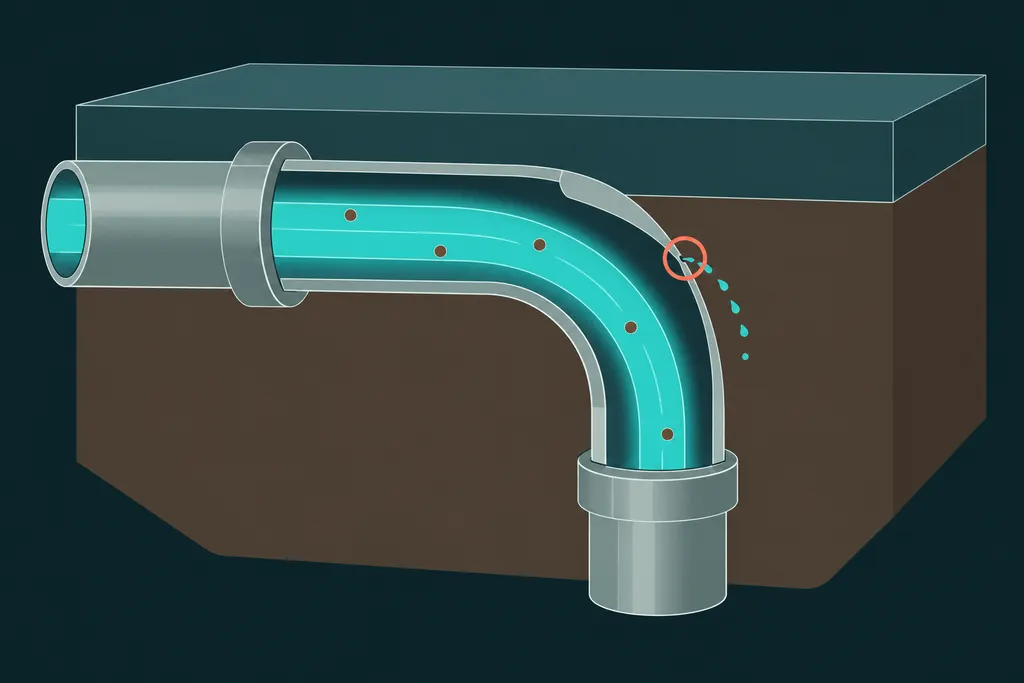
This Old House defines abrasion as debris or sediment carried in the water eroding the pipe. Texas A&M describes a related problem in copper: water moving too fast, “especially when it passes through 90-degree fittings,” erodes the metal, causing leaks “almost always in angle fittings.” That happens when demand is too great for the diameter of the supply line, and the fact sheet calls it “caused not by corrosion but by poor system design.”
High water pressure “puts an added strain on the plumbing system, weakening the pipes,” This Old House says. HomeGuide lists “stress on the pipe from excessive heat or pressure” among the most common causes.
Rich Lewis, whom This Old House describes as a corrosion expert who has appeared on Ask This Old House, explains that copper relies on “a very uniform protective film on the inside of the copper pipe.” This Old House adds that when that film is damaged by aggressive water chemistry, high velocity or improper soldering, the pipe becomes vulnerable to pitting.
Soil movement and foundation shifts
Fixr says soil movement, expanding and contracting, “can be a serious cause of leaks.” Expansive soils, as Roanoke County’s building office describes them, “are high in clay content and change volume with variations in moisture content”: they swell when wet and can shrink considerably when they dry out. Fixr says that over time the soil expanding and contracting “can cause pressure beneath the slab, causing the slab or pipes to move and crack.” This Old House adds seismic activity and tree roots to the forces that “can put tremendous pressure on the slab and the pipes beneath.”
The link can run both ways. Roanoke County notes that the inside of a house can move “if water finds its way under the house when it rains, through landscape watering or through a plumbing leak.” Fixr warns that slab leaks left undetected can erode the soil beneath a foundation.
Note that Fixr uses “excessive pressure” for this soil pressure under the slab, which is a different thing from high water pressure in the pipes.
Installation problems
This Old House says a poorly installed system may have loose connections beneath a slab, and low-quality pipes are more prone to leaks. HomeGuide lists “weak points in plastic or PEX pipes.” Texas A&M adds that, in rare cases, manufacturing defects can make copper more prone to corrosion, causing pinhole leaks “relatively soon after the system is put into service.” Improper soldering, as noted above, can damage copper’s protective film.
How to reduce the risk
This Old House is clear that “slab leaks can’t be entirely prevented.” What its guides and the extension service suggest:
- Have the system checked. This Old House suggests an annual inspection by a licensed plumber for aging pipes, corrosion or small leaks.
- Ask about water pressure. This Old House recommends a pressure regulator on the main line to keep pressure “within a safe range—usually below 80 psi.” Ask a licensed plumber to test your pressure and install one if needed.
- Test your water if you see corrosion signs. Texas A&M advises having suspected corrosive water tested by a laboratory, and notes that treating water “can reduce corrosion to acceptable levels, but generally will not eliminate it.” The right treatment depends on the cause.
- Keep water away from the foundation. In areas with expansive clay soil, This Old House suggests proper drainage away from the foundation.
- Choose materials carefully when you build or renovate. This Old House suggests corrosion-resistant piping such as PEX, installed with proper pipe support and protection.
- Watch the meter. The EPA’s WaterSense test: read the meter, use no water for two hours, read it again. “If the meter changes at all, you probably have a leak.”
If you already see signs, go to slab leak signs and what to do or try the Leak Finder. Costs for each repair method are on slab leak repair cost.
Not sure where the water comes from?Run the Leak Finder →Sources
- This Old House — What Are the Signs of a Slab Leak? (section: What Causes Slab Leaks?) (updated May 27, 2026)
- This Old House — How Much Does Slab Leak Repair Cost? (2026 Guide) (updated Apr 7, 2026)
- Fixr — Slab Leak Repair Cost (section: What Causes a Slab Leak?) (updated May 1, 2025)
- Texas A&M AgriLife Extension — Drinking Water Problems: Corrosion, publication E-616 (July 2012), pp. 1–4
- Roanoke County (Virginia) Office of Building Safety — Expansive Soils Policy & Procedures (revised Feb 2025), p. 1
- HomeGuide — How Much Does a Slab Leak Repair Cost? (Oct 29, 2025)
- U.S. EPA WaterSense — Fix a Leak Week: Checking for Leaks (page last updated Mar 13, 2026)
Checked 2026-10-31
Illustrations on this page are AI-generated to help you picture the situation. They are not photos of real homes, jobs or people.